
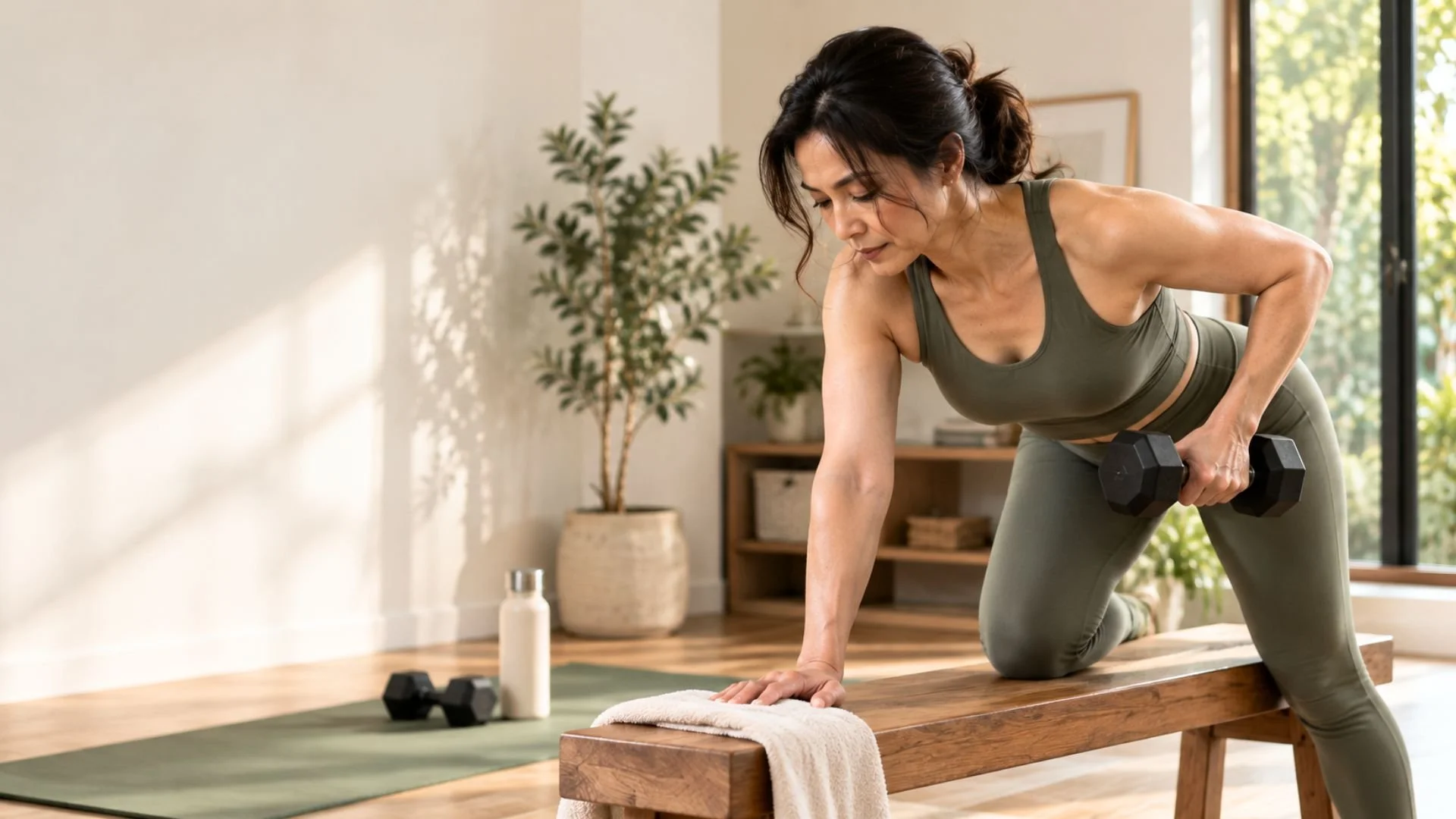
Maybe you've always walked, done yoga, or stayed away from the weights section of the gym. Maybe someone told you lifting would make you "bulky," or that it's risky at your age. Here's the truth: after 40, strength training is one of the most important things you can do for your body, and it's never too late to start.
This guide is written for complete beginners in perimenopause and beyond.
From aesthetics to longevity
For years, exercise was sold to women as a way to look a certain way. In midlife, the reason changes. Muscle is what keeps you climbing stairs, carrying groceries, getting up from the floor and staying independent for decades to come.
Strength training supports:
your bones, which lose density faster after menopause
your blood sugar, because muscle is where your body stores most of the sugar from a meal
your joints, because strong muscles take load off them
your balance, lowering your risk of falls
your mood, energy and sleep
Training for longevity, not aesthetics.
Why muscle matters more after 40
From our 30s, adults gradually lose muscle, often estimated at around 3–8% per decade, unless we actively work to keep it. Estrogen supports muscle repair, so as it falls in perimenopause, building and keeping muscle takes more deliberate effort.
There's another detail that matters: we have different types of muscle fibers. Fast-twitch fibers produce power and speed, the kind you need to catch yourself if you trip. They're the first to decline with age. Your body only calls on them when the effort is genuinely challenging, which is why light weights alone don't reach them. To keep them, you need to lift something that feels heavy for you.
The 6 movement patterns
Instead of memorizing dozens of exercises, focus on six basic movements. Together they train your whole body.
Squat: sitting down and standing up. Start with sit-to-stand from a chair, then goblet squats holding a weight.
Hinge: bending from the hips with a long back, like picking something up from the floor. Try hip hinges, then Romanian deadlifts.
Push: pushing away from you. Wall push-ups, incline push-ups, then a dumbbell chest press.
Pull: pulling towards you. Resistance-band rows, then dumbbell rows.
Lunge: one leg at a time. Supported split squats, then step-ups and lunges.
Carry and core: walking while holding weights (a farmer's carry), and planks or dead bugs.
How heavy should you lift?
Use the Rate of Perceived Exertion (RPE) scale from 1 to 10, where 10 is the hardest effort possible. For most sets, aim for RPE 7 to 8: the weight should feel challenging, with only 2 or 3 more good repetitions left in you at the end of the set.
As a beginner, start lighter, learn the movement well, and increase the weight gradually over weeks. When 10 repetitions start to feel easy, it's time to go a little heavier. Good form always comes before more weight.
A simple weekly plan
Strength training: 2 to 3 days a week, on non-consecutive days. Pick one exercise from each of the six patterns and do 2 to 3 sets of 8 to 12 repetitions.
Cardio: 150 to 300 minutes of moderate activity a week, such as brisk walking, cycling or swimming, spread across the week.
Balance and mobility: a few minutes daily. Standing on one leg while you brush your teeth counts.
Recovery: 7 to 9 hours of sleep, and protein at every meal to help your muscles repair.
A first session can take as little as 30 minutes.
Joint-friendly tips
Warm up for 5 to 10 minutes first: a brisk walk, arm circles, gentle squats.
Work in a range of motion that feels comfortable, and expand it over time.
Muscle soreness for a day or two is normal. Sharp pain in a joint is not: stop and adjust.
Machines and resistance bands are a great, stable place to start.
If you have osteoporosis, a heart condition, high blood pressure or a recent injury, check with your doctor first, and work with a qualified coach.
What about bones?
Bone responds to load. Research in postmenopausal women with low bone mass has found that supervised, progressive high-intensity resistance training improved bone density in the spine and hip. The key words are supervised and progressive: learn the movements well, then build up step by step.
Train with a coach who understands midlife: Live Stronger, Longer™
Our women's strength program, Live Stronger, Longer™, is led by Esther Jusuf, CFT, a certified fitness trainer who works mainly with women over 40. It includes:
a personalized 12-week workout plan built for your body and goals
a 60-minute coaching session each month, online or in person at Studio Kaloria (Pondok Indah) or Grynd Space (Bintaro)
form feedback on two workout videos you send each week
weekly messaging with your coach
Start with the full picture. A Magnolia Hormone & Health Consultation looks at your symptoms, health and goals with a Magnolia Navigator Coach™ and a Magnolia doctor, so your training plan fits the rest of your care. Book your consultation here, and ask about Live Stronger, Longer™.
Sources
American College of Sports Medicine. Guidelines for resistance training in adults.
World Health Organization (2020). Guidelines on physical activity and sedentary behaviour.
Bone Health & Osteoporosis Foundation. Exercise for your bone health.
Watson S.L. et al. (2018). High-intensity resistance and impact training improves bone mineral density and physical function in postmenopausal women with osteopenia and osteoporosis: the LIFTMOR randomized controlled trial. Journal of Bone and Mineral Research.
Henneman E. Size principle of motor unit recruitment.
This article is for education only and is not a substitute for medical advice. Please talk to your doctor before starting a new exercise program.
